News · NetSuite
SuiteScript 2.1 becomes mandatory — and the clock runs until 2028.2
30 September 2026 · Source: SuiteAnswers 1047412 (updated 23 Sep 2026)
Oracle has published the roadmap: SuiteScript 1.0, 2.0 and 2.x are being phased out. From release 2028.2, every custom script in every NetSuite account must run on SuiteScript 2.1 — including the scripts from installed bundles that nobody has touched in years. If your account carries a lot of customisation, start planning now: the transition window looks long, but it contains intermediate steps that bite earlier.
Oracle's timeline
2026.2
SuiteScript 2.1 is the standard for new and existing scripts. Now: identify affected scripts and plan.
2027.1
SuiteScript 1.0 enters end-of-life support — only critical issues are fixed.
2028.1
1.0 scripts can no longer be deployed in new accounts; 2.0/2.x scripts run as 2.1 by default.
2028.2 — deadline
All scripts must be converted to SuiteScript 2.1 to keep working.
Why this is more than an annotation
For clean 2.0 scripts, a test and the new @NApiVersion line are
often enough. But 1.0 scripts (nlapi…) must be
rewritten completely — different module model, different
entry points, different error behaviour. And between 2.0 and 2.1 sit
ECMAScript differences that calculate and sort differently in the details.
That is exactly where the cases come from that pass the test and surface in
the month-end close.
How we manage the transition
We run the migration with experienced NetSuite developers and the know-how from our own plug-ins — and we do not start by writing code, we start by measuring. For that we use Splotch, our analysis tool:
Splotch · account analysis

- Complete inventory: every script, every deployment, every bundle dependency in the account — including the scripts nobody remembers.
- Concrete rewrite proposals: for each script, Splotch proposes how to move it to 2.1.
- Complications are flagged: wherever the conversion is not trivial — 1.0 constructs, ECMAScript traps, dead references — it becomes visible before anyone touches code.
- Data-lean: the export contains metadata and aggregates, no business data.
The result is a prioritised plan instead of a lucky dip: which scripts are done with an annotation and a test, which need a developer, which should simply be retired — and in what order, so operations never stop.
Along the way, the analysis shows what else your account is carrying: failing scheduled scripts, unfiltered bundle scripts, performance hogs on the very transactions your teams use most.
Our offer: account analysis at a fixed price
Health check + performance analysis
Complete Splotch analysis of your account, a written report with a prioritised migration roadmap — and 4 hours of in-person consulting on the results.
- Within one week
- Four hours of in-person consulting
- Deep account analysis with Splotch
- Review by our experienced NetSuite specialists
- Presentation of results
- Best practice for upcoming SuiteScript changes
Reference from the field
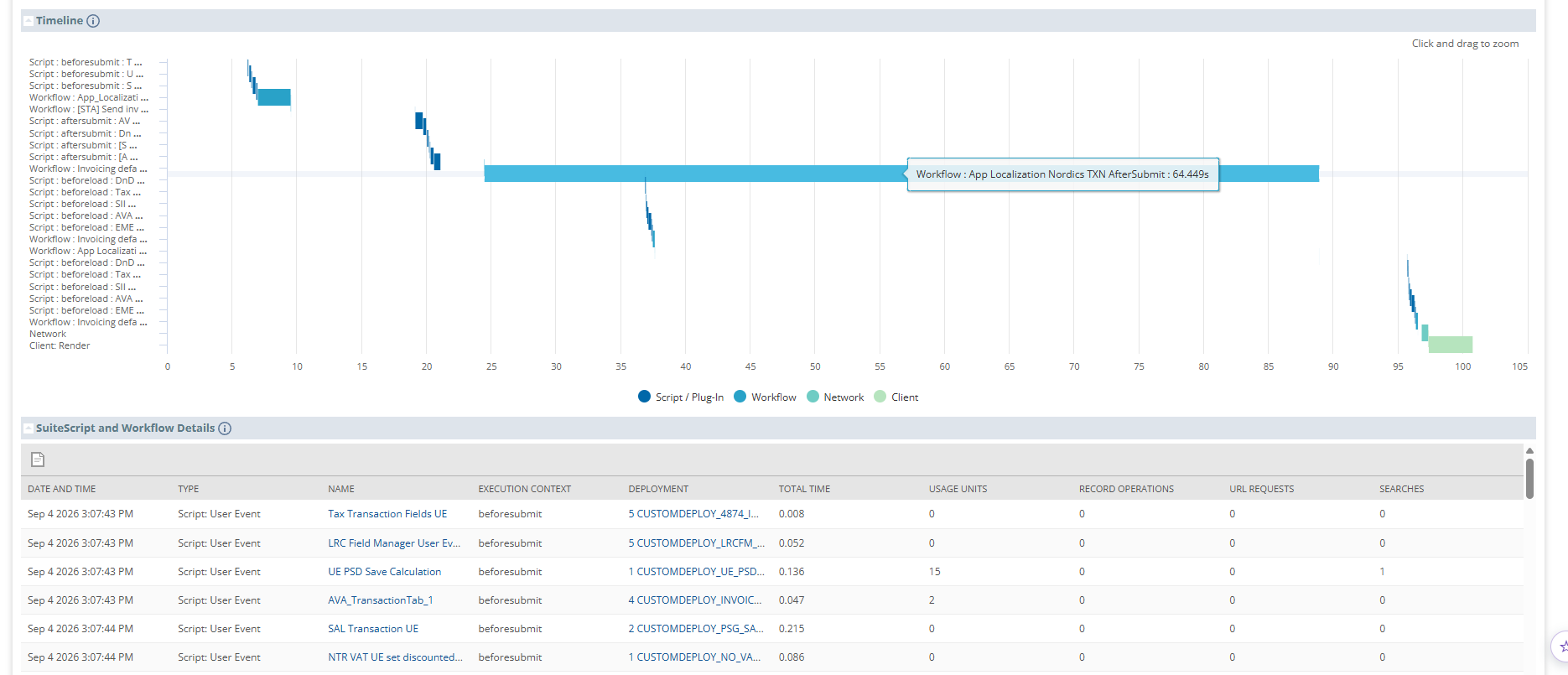
For a European technology company with an international OneWorld setup we ran exactly this analysis — a grown OneWorld account whose users were reporting severe slowness.
The Splotch analysis put the causes in order: it was not the volume of data slowing the account down, but the depth of the script stack on exactly the records users work with every day — plus unhandled script errors and bundle scripts running unfiltered across all subsidiaries. The outcome: a prioritised list of what to switch off, what to filter and what to lift to SuiteScript 2.1 — translated into an action plan in the 4 consulting hours.
Start before 2027.1
From 2027.1, SuiteScript 1.0 problems only get emergency patches. Do the inventory now and you spread the migration across two years of normal operations — start in 2028 and you do it under deadline pressure.