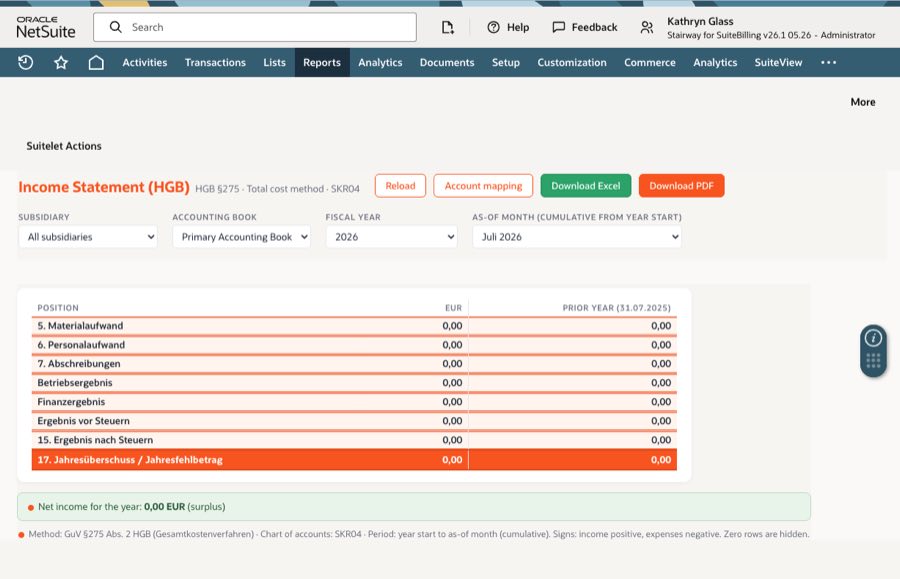
NetSuite has an income statement, but no statutory German structure. The Fourangle income statement produces the P&L by the cost-of-sales method under § 275 (3) HGB directly from the postings in your account — properly structured, with a prior-year column, in a form that tax advisors and auditors read without asking questions.
The amounts are right, the order is not. German statutory accounts require a specific sequence of positions — and the longer an account runs without an assignment, the later anybody notices that the report no longer matches what was posted.
NetSuite groups by account type, not by statutory positions. For the close, somebody has to create that mapping — so far usually in Excel.
German GAAP expects the prior year alongside. Placing it there by hand means comparing two reports produced at different points in time.
In home-grown reports a new account without an assignment simply drops out. The result no longer matches the books — and nobody sees it.
HGB and IFRS side by side need the same report per book. Build a separate tool per view and you maintain two mappings.
A position without a traceable account basis creates questions. And questions during the close always cost more time than the report itself.
A reporting tool alongside needs exports, reconciliation and maintenance. For a report built on the very same postings, that is a long detour.
Accounts are pulled onto the statutory positions automatically: through the number ranges of SKR03 or SKR04 and, where no chart of accounts is assigned, through the NetSuite account type. Anything that should differ you override on the individual account — once set, the override wins.
Month, quarter or fiscal year — the report follows your posting periods, not a separate calendar.
A fit for multi-subsidiary and multi-book structures: HGB and IFRS are reported separately, never mixed.
As soon as prior-year figures exist they sit in their own column — from the same report, calculated in the same moment.
Read it on screen, keep calculating in Excel, hand the PDF to auditors or your tax firm — the same report in three shapes.
Built for substantial clients: the report finishes even when many periods and entities come together.
No export, no intermediate state: the P&L is built from your ledger the moment you open it.
SuiteBundle 703926 is installed into your account like any other bundle. The account mapping is derived automatically from the chart of accounts or the account type.
Accounts that belong elsewhere get their position on the account itself. Whatever stays open is shown in the report.
Pick period, subsidiary and accounting book, open the statement, read it as HTML or pass it on as Excel or PDF.
Structured under § 275 (3) HGB — the method that matches how NetSuite carries inventory.
Via SKR03 or SKR04, with the NetSuite account type as fallback — no external mapping tables.
Assign individual accounts differently; the override wins over the automatic mapping.
By posting period, for a month, a quarter or a fiscal year.
Per entity and per accounting book — a fit for group structures.
Its own column as soon as prior-year figures are available.
Straight from NetSuite, reliable even with large data volumes.
Unassigned balances are shown instead of disappearing quietly.
No data exports, no third-party systems, no manual rework.
The income statement is the sibling of the balance sheet under § 266 HGB: same logic, same mapping, same data. Together with the trial balance and the management report, the German reporting set is complete inside NetSuite — with no Excel file holding the truth.
The statement is made for CFOs, accountants, controllers and tax advisors in companies that book in NetSuite and prepare statutory accounts for their German entity — particularly in groups whose NetSuite setup is geared towards US GAAP.
Native SuiteScript inside the account — the report reads the ledger directly.
SuiteBundle 703926 — installation and updates through NetSuite’s bundle mechanism.
SKR03 and SKR04 by number range, NetSuite account type as fallback, override per account.
Posting period, subsidiary and accounting book.
HTML on screen, Excel (XLSX) and PDF to pass on.
Everything stays in the account — no external service, no copy.
From the chart of accounts: SKR03 and SKR04 have fixed number ranges. Where none is assigned, the NetSuite account type applies as a fallback. Both can be overridden per account.
Cost of sales, § 275 (3) HGB. NetSuite posts production cost through inventory management per transaction, so the cost of the goods and services sold is already there — which is exactly what the cost-of-sales method builds on. The nature-of-expense method would only be possible without inventory management, and then the report loses its basis.
They do not disappear. Unassigned balances are shown, so the sum of the positions matches what was actually posted — and you see immediately where a mapping is still missing.
Yes, as soon as prior-year figures exist. The column comes from the same report, so from the same data — not from an older file.
Yes. The report runs per accounting book. You produce it once for one book and once for the other, without the books mixing.
Yes — both reports work on the same postings and use the same logic for mapping and overrides. The result for the year is therefore identical on both sides.
No. The report runs inside your NetSuite account; the only thing that leaves is the finished file, if you create one.
As a PDF or Excel file from NetSuite. Anyone who wants to check its origin gets the report together with the positions it is composed of.
We produce the income statement for a fiscal year of your choice — and you compare it with what your statutory accounts show today.