News · Partner
Splotch: your NetSuite account as a map
1 October 2026 · Partner news · splotch.ink

Splotch turns a grown NetSuite account into a clear map: what runs where, what depends on what — and what happens if you change something. What used to take weeks of diagnosis happens on a single product surface.
Every grown NetSuite account carries years of customisation: scripts, workflows, fields, integrations, bundles — much of it nobody remembers in detail. That is exactly where Splotch starts: it reads the account, translates SuiteScript, XML and configuration into a human-friendly structure, and puts a governance layer on top. NetSuite remains your ERP — Splotch replaces nothing, it makes it legible and changeable.
What Splotch delivers
The map of your system
Visualises how your account really works — customisations, dependencies, integrations — with versioning and governance on top.
Impact analysis before the change
New geographies, product lines or acquisitions: Splotch shows downstream effects and friction points before anything ships.
Integrations under control
Analyses customisations, integrations and dependencies — the diagnostic and design work that used to take weeks happens in hours.
Reversible and sandbox-safe
Every proposed change is visible, reviewable and reversible — with an audit trail, before it reaches production.
Costs made visible
Overlapping tools, unused integrations, redundant software: Splotch reveals consolidation opportunities across the landscape.
Ready for AI
The governance layer that lets AI act safely inside the system — a deterministic NetSuite, controlled change.
How we use Splotch. In our health checks and performance analyses, Splotch delivers the complete inventory of the account — and for the SuiteScript 2.1 migration (deadline 2028.2) it proposes, per script, how to convert and flags where complications wait. What that looks like in practice: see the reference below.
NetSuite Next and Splotch: two different scopes
With NetSuite Next, Oracle builds AI deep into the product — assistants, analytics, automation in daily operations. That is AI for working with the ERP. What it does not cover is working on the ERP — understanding and safely changing the grown customisation.
NetSuite Next
AI in daily operations
Speed up entry, explain the numbers, automate standard processes — inside the product, by Oracle.
Splotch
AI on the system itself
Map the customisation, version changes, check impact, ship safely — the governance layer above the account.
No contradiction — quite the opposite: NetSuite is native AI territory, because it has always had the open architecture for it — SuiteScript, SuiteQL, SuiteTalk, cleanly accessible metadata. That openness is exactly what Splotch builds on, closing the gap: it brings the internal NetSuite knowledge — object model, dependencies, platform quirks — that lets AI work on the system effectively. A generic AI assistant, however good — Claude included — still has to guess in those places. Splotch knows.
Our offer: account analysis at a fixed price
Health check + performance analysis
Complete Splotch analysis of your NetSuite account, a written report with prioritised actions — and 4 hours of in-person consulting on the results.
- Within one week
- Four hours of in-person consulting
- Deep account analysis with Splotch
- Review by our experienced NetSuite specialists
- Presentation of results
- Best practice for upcoming SuiteScript changes
Reference from the field
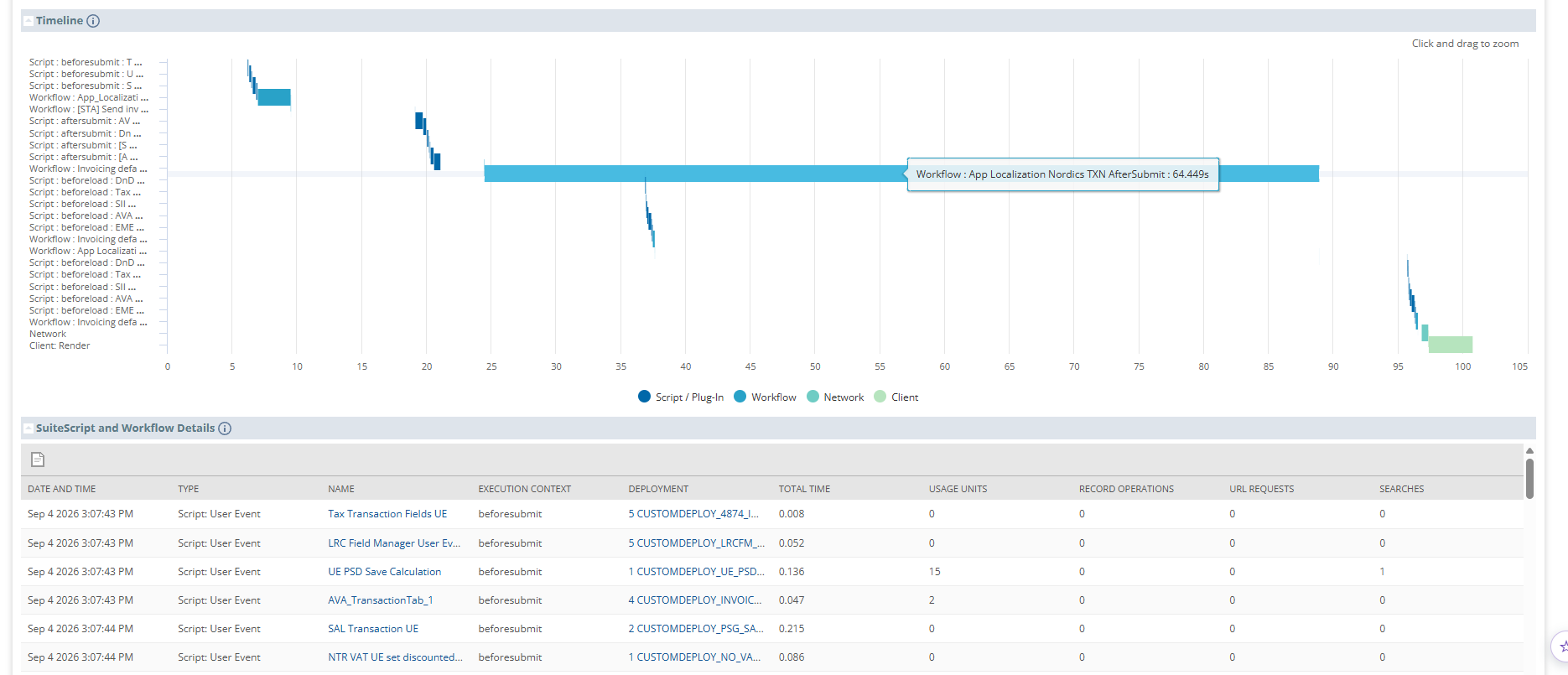
For a European technology company with an international OneWorld setup we ran exactly this Splotch analysis — a grown OneWorld account whose users were reporting severe slowness.
Splotch put the causes in order: it was not the volume of data slowing the account down, but the depth of the script stack on exactly the records users work with every day — plus unhandled script errors and bundle scripts running unfiltered across all subsidiaries. The outcome: a prioritised list of what to switch off, what to filter and what to modernise.
Who Splotch is for
Splotch fits mid-market and enterprise companies on NetSuite where a strategic initiative has to run through the system — after an acquisition, under new leadership, with an AI mandate, or ahead of a NetSuite renewal. No migration away from NetSuite is needed: Splotch is the layer on top, not the replacement.